How to Improve Form Completion Rate (What the Research Says)
Form completion rate is the share of people who finish a form they started. See what survey and UX research show actually moves it, backed by evidence.
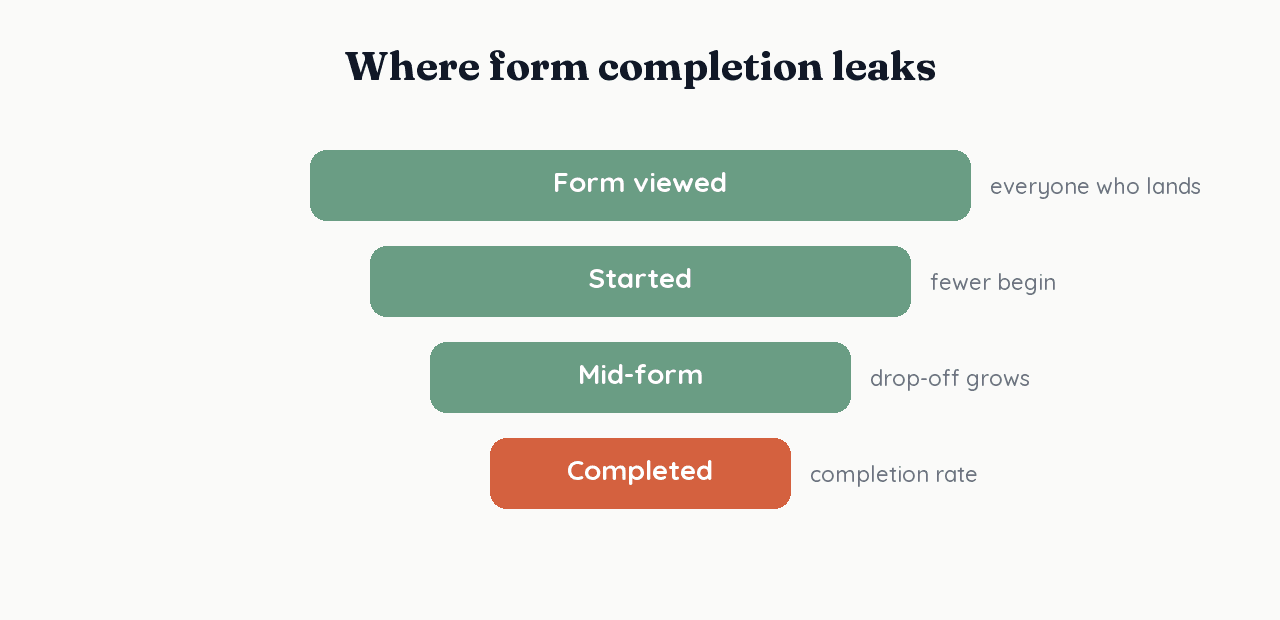
Form completion rate is the percentage of people who finish a form out of everyone who starts it. It is the single most important number for any form, and the research on what improves it is remarkably consistent: reduce length, reduce effort, and only ask what's relevant.
What is a good form completion rate?
There is no universal benchmark — it depends on audience, intent, and how much you ask — so the useful comparison is your form against itself over time. Track starts, completions, and where people drop off, then change one thing and measure. Absolute numbers from other companies' forms are rarely comparable to yours.
Does form length really reduce completion?
Yes — this is one of the best-supported findings in survey methodology. In a controlled web-survey experiment, Galesic and Bosnjak (2009) found that longer stated questionnaire length lowered participation and degraded response quality in the later questions. Peytchev (2009) studied breakoff — people abandoning partway — and tied it to respondent burden. Every additional question is a chance to lose someone.
How much does cutting fields help?
Enough that it's the highest-leverage change you can usually make. Baymard Institute's research on checkout flows found the average checkout asks 11.3 form fields when around 8 are actually needed. The lesson generalizes: audit every field and delete or defer anything you don't truly need at that moment.
What actually moves completion rate?
The evidence points to a short list:
- Ask fewer questions. Cut optional fields; collect the rest later. (Galesic & Bosnjak, 2009)
- Lower perceived effort. One question at a time and a visible sense of progress reduce the burden that drives breakoff (Peytchev, 2009).
- Only ask what's relevant. Use conditional logic so no one answers questions that don't apply to them.
- Ask clearly. Confusing questions cause hesitation and drop-off — see how to ask the right questions.
How RoundPushPin helps
RoundPushPin's conversational design lowers perceived effort by asking one question at a time, and its conditional logic shows only relevant questions — both of which target the exact factors the research links to completion. And because responses are stored relationally, you can measure completion and drop-off per question directly in SQL.
Frequently asked questions
- What is a good form completion rate?
- There's no universal benchmark — it varies by audience, intent, and length — so compare your form against itself over time rather than to others. Track starts, completions, and per-question drop-off.
- Does reducing the number of form fields increase conversions?
- Usually yes. Research links longer forms to lower completion, and Baymard found typical checkouts ask about 11 fields when around 8 suffice. Cutting unnecessary fields is often the single highest-leverage change.
- Why do people abandon forms?
- Mostly effort: too many questions, irrelevant fields, unclear wording, and no sense of progress. Survey research ties 'breakoff' to respondent burden, so lowering effort is the core fix.
Sources
- Galesic, M. & Bosnjak, M. (2009) — Effects of questionnaire length on participation and indicators of response quality in a web survey — Public Opinion Quarterly
- Peytchev, A. (2009) — Survey breakoff — Public Opinion Quarterly
- Checkout flows have an average of 11.3 form fields — Baymard Institute
Keep reading
How to Build Trust in Your Forms (So People Complete Them)
People won't hand data to a form they don't trust. A research-backed guide to how visitors judge credibility and the trust signals that matter on forms.
Form Friction: What Causes It and How to Reduce It
Form friction is the effort and hesitation between a respondent and 'submit'. A research-backed look at what causes it, and practical ways to cut it down.