Conditional Logic and Skip Logic in Forms
Conditional logic shows or hides questions based on previous answers, so each respondent sees only what's relevant. Learn skip logic, branching, and graphs.
Conditional logic — also called skip logic or branching — shows, hides, or reorders questions based on what a respondent has already answered. It is how a form adapts to each person so they only ever see questions that apply to them.
What is skip logic in a form?
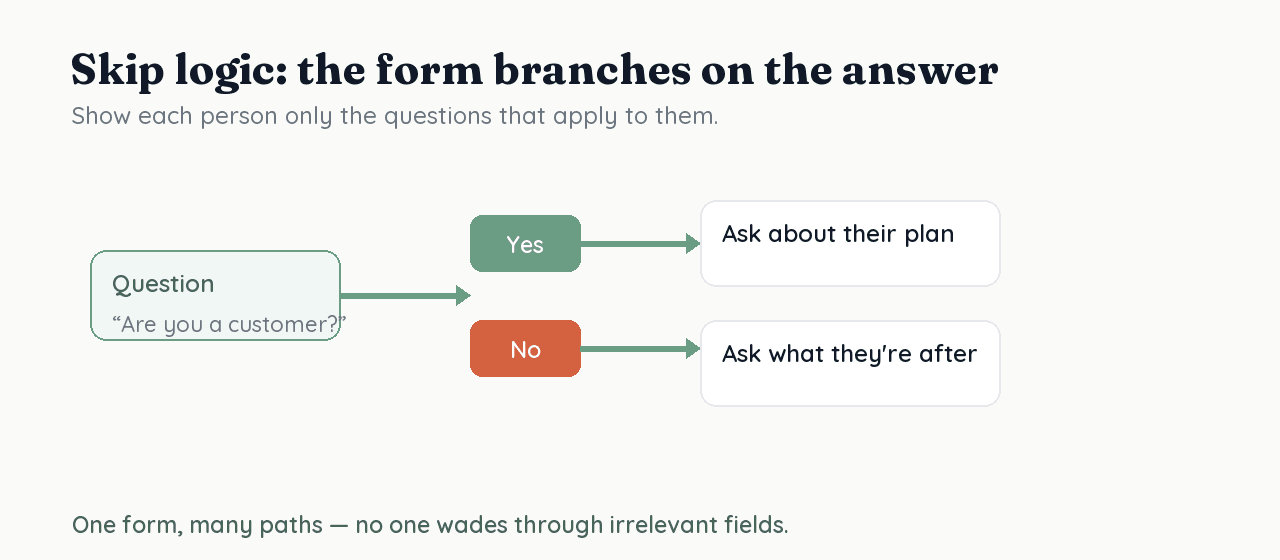
Skip logic is a rule that changes the path through a form based on an answer. "If the respondent selects No, skip the three follow-up questions" is skip logic; so is routing enterprise and individual users down different branches. Instead of one rigid sequence, the form becomes a set of paths, and each respondent travels only the relevant one.
Why use conditional logic?
Because relevance reduces length, and length drives abandonment. Showing only applicable questions is progressive disclosure — a long-standing UX principle for cutting cognitive load (Nielsen Norman Group) — and shorter, more relevant paths align with the finding that questionnaire length lowers participation and response quality (Galesic & Bosnjak, 2009). Conditional logic lets a form be comprehensive for the few without being long for everyone.
What's the difference between skip logic and branching?
They're the same idea at different scales. Skip logic usually means jumping over individual questions; branching means whole alternative sections or paths. Both are conditional logic — rules connecting an answer to what comes next.
How RoundPushPin models conditional logic
RoundPushPin represents logic as a visual graph of edges between questions rather than tangled nested rules. You draw the paths — this answer leads here, that answer leads there — and the renderer evaluates the edges as the respondent moves through the form. The result is comprehensive forms that still feel short, which is exactly what completion rate rewards.
Frequently asked questions
- What is skip logic in a form?
- Skip logic is a rule that changes the path through a form based on an answer — for example, skipping follow-up questions when someone answers 'No'. The form becomes a set of paths, and each respondent travels only the relevant one.
- Does conditional logic improve completion?
- Generally yes, because it hides irrelevant questions and shortens each respondent's path, and survey research links shorter, lower-burden forms to higher completion. It lets a form be thorough for the few without being long for everyone.
- What's the difference between skip logic and branching?
- They're the same idea at different scales: skip logic usually jumps over individual questions, while branching routes respondents down whole alternative sections. Both connect an answer to what comes next.
Sources
- Progressive Disclosure (Jakob Nielsen) — Nielsen Norman Group
- Galesic, M. & Bosnjak, M. (2009) — Effects of questionnaire length on participation and response quality — Public Opinion Quarterly
Keep reading
Form Friction: What Causes It and How to Reduce It
Form friction is the effort and hesitation between a respondent and 'submit'. A research-backed look at what causes it, and practical ways to cut it down.
How to Ask the Right Questions in a Form
The wording and order of your questions shape the answers you get, and whether people finish. Research-backed rules for writing better form questions.