Form Friction: What Causes It and How to Reduce It
Form friction is the effort and hesitation between a respondent and 'submit'. A research-backed look at what causes it, and practical ways to cut it down.
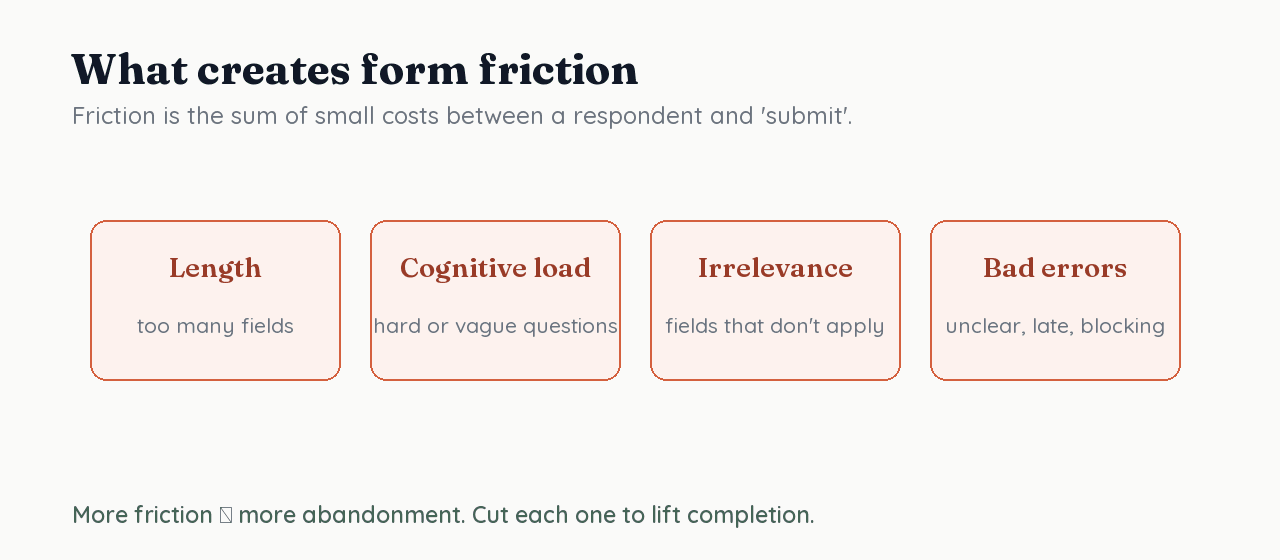
Form friction is the sum of everything that stands between a respondent and the submit button — every extra field, moment of confusion, or irrelevant question that makes finishing feel like work. Reduce it and more people complete; ignore it and they leave.
What is form friction?
Form friction is any effort or hesitation a form imposes on its way to "submit". It's the cognitive and physical cost of answering — reading, deciding, typing, recovering from errors — plus the doubt a confusing or intrusive question creates. Friction isn't one thing; it's the accumulation of small costs, and each one is a chance to lose someone.
What causes friction in forms?
Mostly length and cognitive load, then irrelevance and confusion. Longer forms reduce participation and response quality (Galesic & Bosnjak, 2009), and when a question is burdensome people satisfice — taking mental shortcuts or abandoning rather than answering well (Krosnick, 1991). On top of that: fields that don't apply, vague or double-barrelled wording, and unclear error messages each add friction.
How do you reduce form friction?
Remove reasons to stop, one at a time:
- Ask fewer questions — cut anything you won't act on.
- Show one question at a time — the conversational format is progressive disclosure, a long-standing way to cut cognitive load (Nielsen Norman Group).
- Hide irrelevant fields with conditional logic.
- Phrase questions plainly — see how to ask the right questions.
- Make errors recoverable — clear, inline, specific.
Does removing friction hurt your data?
No — lower friction usually improves data, because burdened respondents satisfice. Krosnick (1991) showed that high effort pushes people toward low-quality shortcut answers, so reducing burden tends to raise answer quality, not lower it. The exception is removing a genuinely necessary question — friction reduction means cutting the unnecessary, not the important.
How RoundPushPin reduces form friction
RoundPushPin is built to keep friction low: one question at a time, relevant fields only, and clean validation — with the data still fully structured underneath. Conversational delivery and graph-based conditional logic cut the length and irrelevance that drive abandonment, and you can measure the payoff in completion rate straight from your data.
Frequently asked questions
- What is form friction?
- Form friction is anything that raises the effort or hesitation between a respondent and submitting — too many fields, confusing questions, irrelevant steps, unclear errors, or a layout that feels long. More friction means more abandonment.
- What causes the most form friction?
- Length and cognitive load. Research links longer forms to lower completion and quality, and burdensome questions push people to take shortcuts or quit. Irrelevant fields, vague wording, and poor error handling add more.
- How do you reduce form friction?
- Ask fewer questions, show one at a time, hide irrelevant fields with conditional logic, phrase questions plainly, and give clear inline error recovery. Each removes a reason to hesitate or leave.
Sources
- Krosnick, J. A. (1991) — Response strategies for coping with the cognitive demands of attitude measures in surveys — Applied Cognitive Psychology
- Galesic, M. & Bosnjak, M. (2009) — Effects of questionnaire length on participation and response quality — Public Opinion Quarterly
- Progressive Disclosure (Jakob Nielsen) — Nielsen Norman Group
Keep reading
How to Build Trust in Your Forms (So People Complete Them)
People won't hand data to a form they don't trust. A research-backed guide to how visitors judge credibility and the trust signals that matter on forms.
How to Ask the Right Questions in a Form
The wording and order of your questions shape the answers you get, and whether people finish. Research-backed rules for writing better form questions.