How to Query Form Data With SQL
When form responses live in a relational database, answer questions with SQL instead of spreadsheets. The queries that matter: filtering, aggregating, joining.

Querying form data with SQL means asking questions of your responses directly in the database — filtering, grouping, and joining them — instead of exporting a file and pivoting in a spreadsheet. It only works when responses are stored relationally, with each question as a typed column.
Can you query form responses with SQL?
You can when responses live in a relational database. If a form tool stores answers as JSON blobs you have to deserialize every document first; if each question is a typed column, you query it like any other table. The difference is the storage model — see form data architecture for why it matters.
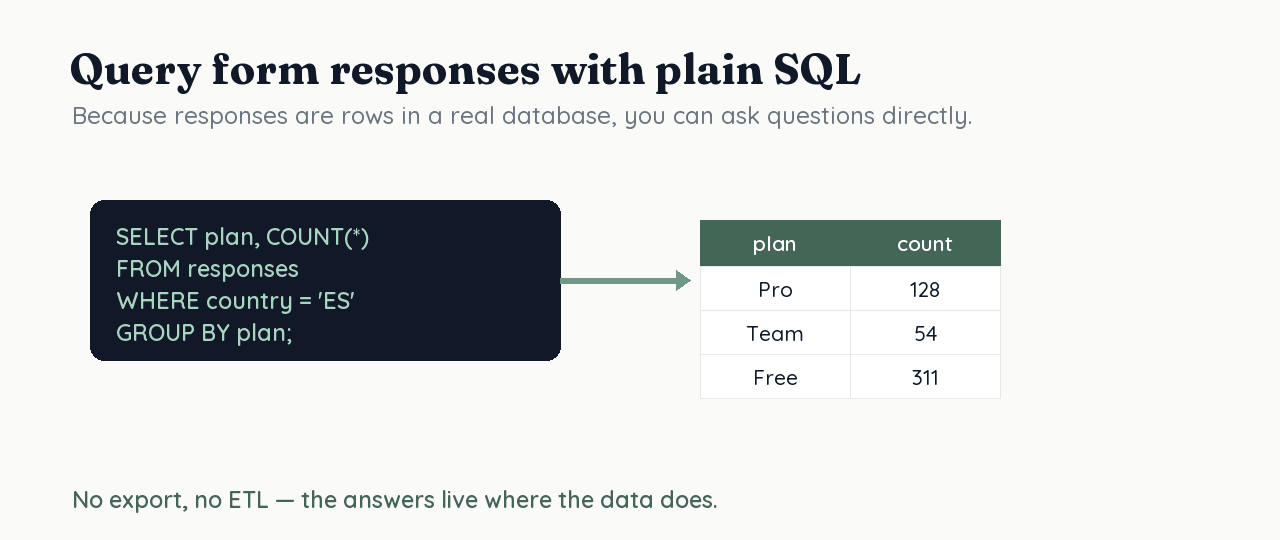
What can you actually ask?
The three workhorses are filtering, aggregating, and joining:
- Filter to a segment:
SELECT * FROM responses WHERE role = 'Engineer' AND submitted_at > '2026-01-01' - Aggregate to a metric:
SELECT role, COUNT(*) FROM responses GROUP BY role— PostgreSQL's aggregate functions (COUNT,AVG,MIN,MAX) turn raw rows into answers. - Join to context: connect responses to your
usersororderstable on a shared key to analyze answers alongside the rest of your data.
How do you analyze completion or drop-off with SQL?
Group by question and count non-null answers. Because each question is its own column, a query like SELECT COUNT(question_3) / COUNT(*)::float FROM responses gives the completion ratio for that question — the kind of drop-off analysis that is painful when the whole response is one opaque blob.
How RoundPushPin makes responses queryable
RoundPushPin stores every response relationally, so your data is queryable from day one — no export step, no reshaping. Connect your own SQL client or export to BigQuery when you want to analyze form data next to everything else.
Frequently asked questions
- Can you run SQL on form responses?
- Yes, when responses are stored relationally — each question as a typed column. You can filter, aggregate, and join them like any table. If a tool stores answers as JSON blobs, you must deserialize them first.
- How do you analyze form drop-off?
- Group by question and count non-null answers: comparing answered versus total per question reveals where people stop. This is simple when each question is its own column and painful when the response is one opaque blob.
- How do you join form data with other tables?
- Connect responses to another table on a shared key, such as a user ID, with a SQL JOIN. Relational storage makes this direct; RoundPushPin stores responses this way so they sit alongside your other data.
Sources
- SELECT — PostgreSQL Global Development Group
- Aggregate Functions — PostgreSQL Global Development Group
- Joins Between Tables — PostgreSQL Global Development Group
Keep reading
How to Export Form Responses to CSV
CSV is the universal format for moving form responses into spreadsheets and other tools. Learn what a clean export looks like and the pitfalls of messy ones.
How to Store Form Responses in a Database
Storing form responses in a relational database: when a spreadsheet stops being enough, how to model questions as typed columns, and how RoundPushPin does it.