How to A/B Test Forms (and Read the Results)
A/B testing a form means showing two versions to comparable groups to see which converts better. Learn what to test, how to read results, and how long to run.
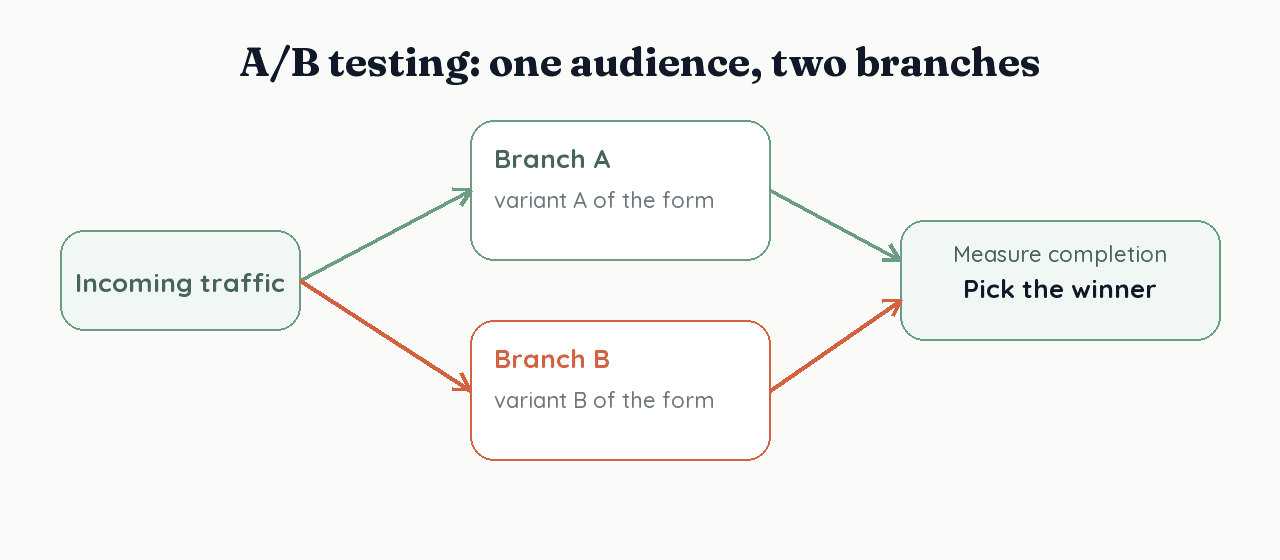
A/B testing a form means showing two versions of it to comparable, randomly assigned groups and measuring which one performs better — usually on completion rate. Done properly it tells you what actually works instead of what you assume works; done sloppily it produces confident, wrong conclusions.
Can you A/B test a form?
Yes — a form is well suited to A/B testing because it has a clear, measurable outcome: did the person finish it. You split incoming respondents randomly between version A and version B, keep everything else equal, and compare completion. Random assignment is the core idea from controlled experiments (Kohavi, Tang & Xu, 2020): it's what lets you credit the difference to your change rather than to chance or to who happened to see which version.
What should you A/B test on a form?
Test one meaningful change at a time, so you can attribute any difference to it. High-leverage things to test on a form:
- Length — fewer fields vs more (the change most likely to move completion).
- One question at a time vs all-on-one-page — the conversational format vs a classic layout.
- Question wording — since wording shapes answers and effort.
- Question order — front-loading easy questions vs sensitive ones.
- The call to action and intro copy.
Changing several things at once is fine for shipping, but then you won't know which change caused the result.
How do you read A/B test results?
Compare the primary metric between variants and ask whether the difference is real or noise — using a significance test, not eyeballing. Compute completion rate for each variant and a confidence interval or p-value; a gap that isn't statistically significant is not yet a result. The most common mistake is peeking — repeatedly checking and stopping the moment it looks significant — which dramatically inflates false positives (Evan Miller, "How Not to Run an A/B Test"). Decide your metric and stopping rule before you start, and read per-question drop-off too, so you can see where a variant helped or hurt.
How long should you run a form A/B test?
Long enough to reach the sample size you set in advance, and across full business cycles — not until it looks good. Estimate the sample with a power calculation based on your baseline completion rate and the smallest improvement worth detecting; smaller effects need much larger samples. Run for whole weeks to avoid day-of-week bias, and avoid stopping early on an exciting-but-underpowered result.
How RoundPushPin helps you test and read forms
Because RoundPushPin stores responses relationally, the metrics an A/B test needs are already in the data — no tracking project required. Completion rate and per-question drop-off come straight from the database with a SQL query, and because you can run one master template in many versions, standing up an A and a B variant is quick — see RoundPushPin's A/B testing feature. Structured data is what turns a form test from guesswork into a measurable experiment.
Frequently asked questions
- What is A/B testing for forms?
- It's a controlled experiment: visitors are split randomly between two versions of a form, and you compare a metric — usually completion rate — to see which performs better. Random assignment is what lets you attribute the difference to the change rather than to chance or audience.
- How big a sample do I need to A/B test a form?
- Enough to detect the effect size you care about — smaller expected improvements need larger samples. Decide the sample size before you start using a calculator, and don't stop early just because a result looks significant; peeking inflates false positives.
- What metric should I track for a form A/B test?
- Usually completion rate (finishers ÷ starters), plus per-question drop-off to see where a variant helps or hurts. Pick one primary metric before the test so you're not cherry-picking afterward.
Sources
- Kohavi, R., Tang, D., & Xu, Y. (2020) — Trustworthy Online Controlled Experiments: A Practical Guide to A/B Testing — Cambridge University Press
- Evan Miller — How Not to Run an A/B Test — Evan Miller
Keep reading
Sequential Testing: Stop Form A/B Tests Early, Safely
Sequential testing lets you end a form A/B test as soon as there's a real winner — without the peeking that inflates false positives. A researcher's guide.
Landing Page Forms for Paid Traffic: Meta & Google Ads
You paid for every click — don't lose it at the form. Best practices for landing page forms on Meta and Google traffic: message match, speed, and a minimal ask.