One Template, Many Versions: Build a Form Once
Instead of cloning a form for every audience, build one master template and generate every version from it — a single source of truth that scales.
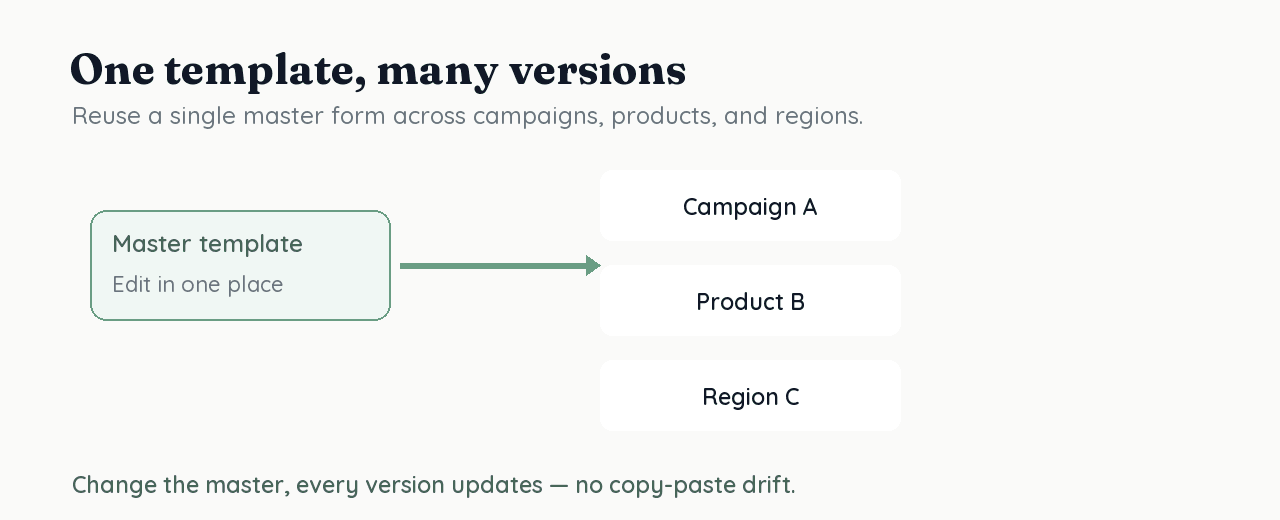
"One template, many versions" means you design a form a single time and generate every variant — per language, product, course, or campaign — from that one master. The master is the single source of truth, so the versions can never quietly drift apart.
What problem does a master template solve?
It solves duplication drift. The moment you clone a form, the copies start diverging: a fix here, an extra question there, a translation that lags. The Don't Repeat Yourself principle — that every piece of knowledge should have one authoritative representation — exists because duplicated knowledge is where inconsistencies and bugs breed. A form used ten ways should be defined once, not ten times.
How is this different from duplicating a form?
Duplicating creates independent copies that you maintain separately. A master template creates derived versions that stay connected to their source: change the master question and every version updates, because the versions are projections of one definition rather than forks of it.
What stays in sync across versions?
Wording, structure, logic, and validation. When the master changes, the change propagates — so all versions ask the same questions, branch the same way, and enforce the same rules. That consistency is what makes responses from different versions comparable in one dataset.
How RoundPushPin does it
RoundPushPin is built around the master template: create it once, replicate it in seconds for any audience, and keep editing the master to update every version at once. Pair it with automatic translation for languages and repeatable contexts for per-item question sets — and every version still sends answers to a single, queryable store.
Frequently asked questions
- How do I reuse a form across products or campaigns?
- Build one master template and generate each version from it, rather than cloning and editing. Versions stay connected to the source, so editing the master updates them all and they can't drift apart.
- What is a master template?
- A single authoritative definition of a form that every version derives from — the single source of truth. Wording, structure, logic, and validation all flow from it to the versions.
- Why not just duplicate the form?
- Because duplicates diverge: each copy is maintained separately, so fixes and translations fall out of sync. A master template avoids that by making versions projections of one definition.
Sources
- The Pragmatic Programmer — DRY (Don't Repeat Yourself) — Pragmatic Bookshelf
Keep reading
Repeatable Contexts: Ask the Same Questions for Many Items
Repeatable contexts let you ask one set of questions per item in a list — products, students, events — without rebuilding the form. How RoundPushPin models it.
How to Build Multilingual Forms
Multilingual forms mean more than translation. Learn translation vs localization, keeping versions in sync, and turning one template into 10+ languages.