Self-Hosted Forms: Own Your Form Data
Self-hosted forms run on your own infrastructure, so responses live in a database you control. Learn what self-hosting means and why data ownership matters.
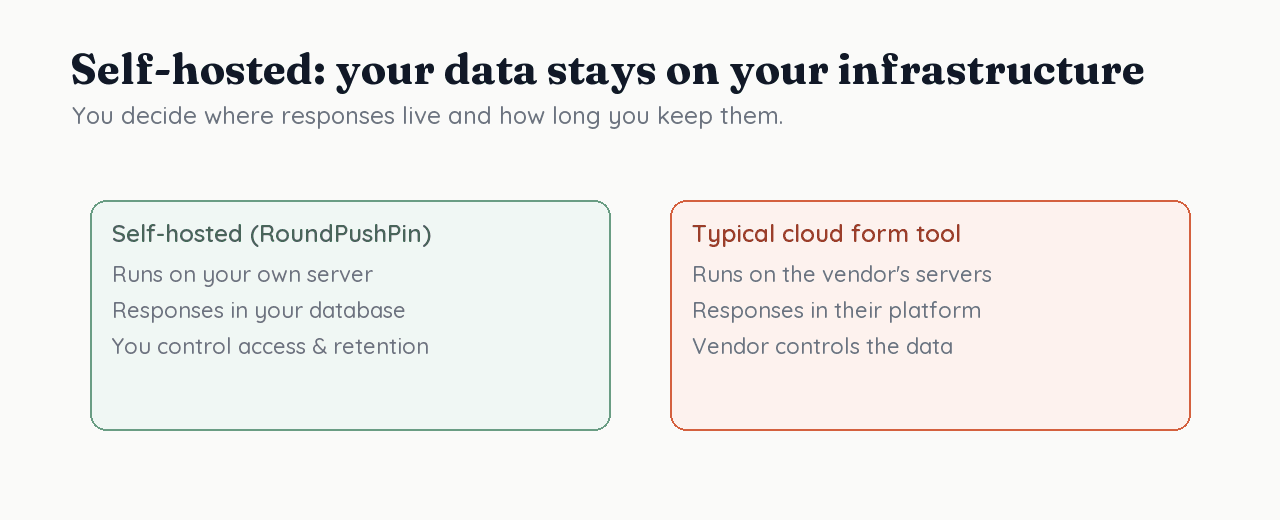
A self-hosted form runs on infrastructure you control, with responses stored in your own database rather than a vendor's cloud. It is the most direct form of data ownership: no third party sits between you and your respondents' answers.
What does "self-hosted" actually mean?
It means you run the form application and its database on servers you choose — your own cloud account, a private server, or on-prem — instead of submitting data to a SaaS vendor's platform. The form still works the same for respondents; the difference is custody. With a hosted tool the vendor holds the data and you access it through their product; self-hosted, you hold it.
Why does self-hosting matter for privacy?
Because it removes a party from the data path and puts residency in your hands. Where data is stored and transferred is a real concern under regimes like the GDPR, whose Chapter V governs transfers of personal data across borders. When you self-host, you decide which region and provider hold the data, rather than inheriting a vendor's choices — which simplifies data ownership and privacy generally.
What are the trade-offs?
Self-hosting trades convenience for control. You run the infrastructure — updates, backups, uptime — which a fully-managed SaaS handles for you. The upside is ownership: direct database access, your own residency and retention rules, and no vendor lock-in. Good tooling narrows the gap; a one-command Docker setup and a typed schema (via tools like Drizzle) make running your own stack far less work than it used to be.
How RoundPushPin does self-hosting
RoundPushPin is self-hosted: a Docker Compose file brings up the app with PostgreSQL in one command, so every response lands in a relational database you own and can query with SQL. You get the conversational experience of a hosted tool with the ownership of running your own — the foundation for GDPR-compliant forms.
Frequently asked questions
- What does a self-hosted form mean?
- It means the form application and its database run on infrastructure you control, so responses are stored in your own database rather than a vendor's cloud. Respondents see the same form; you hold the data.
- Are self-hosted forms worth the trade-off?
- If data ownership, residency, or privacy matter, usually yes. You take on running the infrastructure, but you gain direct database access, your own retention rules, and no vendor lock-in. Good tooling narrows the operational gap.
- How do I self-host RoundPushPin?
- RoundPushPin ships with a Docker Compose setup that brings up the app and PostgreSQL in one command, so every response lands in a relational database you own and can query with SQL.
Sources
- Regulation (EU) 2016/679 (GDPR) — Chapter V, transfers of personal data to third countries — EUR-Lex, European Union
- Drizzle ORM — Overview — Drizzle
Keep reading
How to Build GDPR-Compliant Forms
GDPR-compliant forms collect only what you need, on a lawful basis, with clear consent and retention control. Learn the principles and how self-hosting helps.
Landing Page Forms for Paid Traffic: Meta & Google Ads
You paid for every click — don't lose it at the form. Best practices for landing page forms on Meta and Google traffic: message match, speed, and a minimal ask.