Form Data Architecture: How to Store Responses Right
Form data architecture is how a tool persists, structures, and exposes responses. Compare flat files, JSON blobs, and relational databases, and why it matters.

Form data architecture is how a form tool persists, structures, and exposes the answers people submit. It is the most consequential — and most ignored — decision in form building: the storage model you start with determines whether your responses stay a queryable asset or become a pile of exports you fight with later.
What is form data architecture?
Form data architecture is the underlying model a form platform uses to store responses — flat rows, nested JSON documents, or normalized relational tables — and the interfaces it gives you to read that data back. Two forms can look identical to a respondent while storing answers in completely different ways underneath, and that difference is what dictates how you query, join, validate, and export later.
Why does the way you store form data matter?
Because the storage model is hard to change after the fact, and it caps what you can do with the data. A model with no schema accepts anything but lets nothing be trusted, indexed, or joined; a structured model enforces types and relationships so the data is usable the moment it lands. The relational model — first described by E. F. Codd in 1970 — exists precisely to keep data consistent, queryable, and free of duplication, and it still underpins most serious data work today.
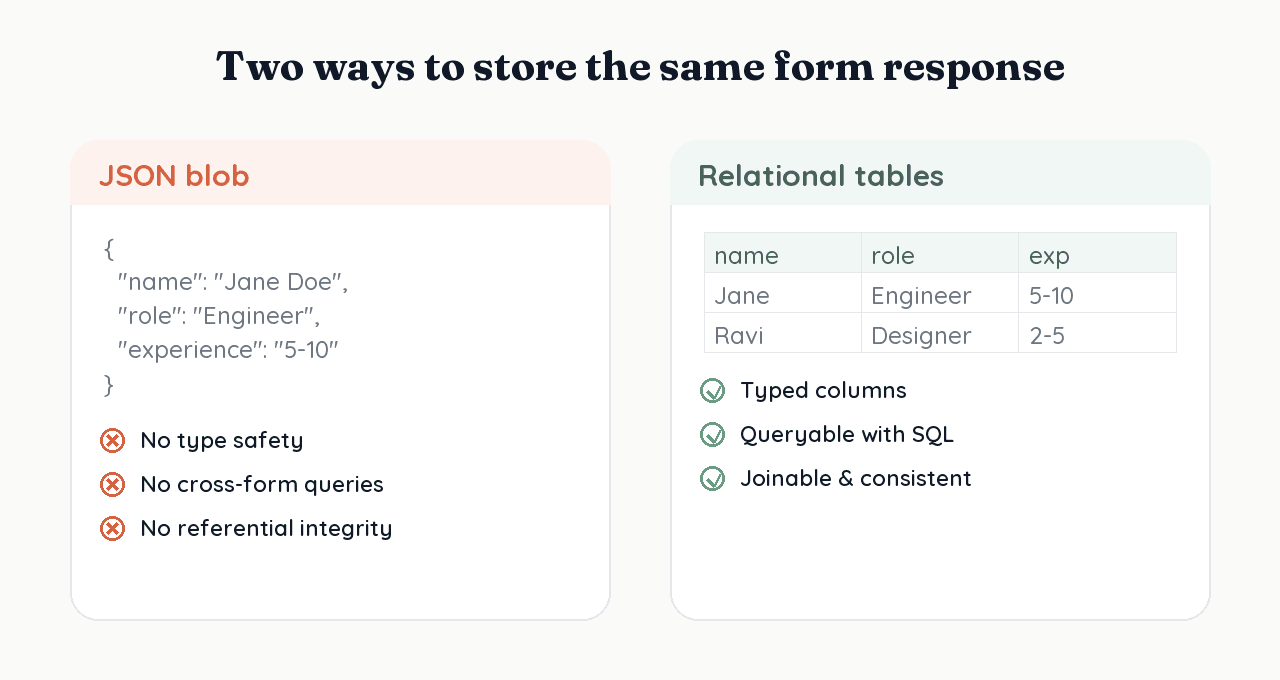
Flat files vs JSON blobs vs relational tables
There are three common ways form tools store responses, in increasing order of structure:
- Flat files / spreadsheets. One row per submission, one column per question. Simple and instantly readable, but fragile — columns drift as the form changes, types are unenforced, and joining to other data means manual work.
- JSON blobs. The whole response serialized into one document. Flexible and easy to write, but you lose referential integrity, type safety, and efficient querying. PostgreSQL can store JSON, but its own documentation notes that JSON should be used when the structure is genuinely variable — not as a default for data you intend to query relationally.
- Relational tables. Each question becomes a typed column and each response a row, with foreign keys connecting related records. More upfront discipline, but the data is queryable with SQL, joinable to other systems, and protected by constraints from day one.
How RoundPushPin approaches form data architecture
RoundPushPin maps every form to a real PostgreSQL schema rather than a blob. Each question becomes a typed column, each response a row, and form structure is versioned with migrations — so your responses are queryable, joinable, and exportable to CSV or BigQuery without an ETL project. The sections below go deeper on each part of this model.
Frequently asked questions
- What is the best way to store form data?
- For data you'll query or join, a relational database is the best fit: each question becomes a typed column and each response a row, so the data stays consistent and queryable. Flat files and JSON blobs are simpler but harder to analyze and validate.
- Is JSON or relational storage better for form responses?
- Relational storage is better when you need to query, join, or validate responses, because it enforces types and relationships. JSON is better only when the structure is genuinely variable — and most form data is regular, so it benefits from a relational model.
- Does RoundPushPin store form responses in a database?
- Yes. RoundPushPin maps every form to a PostgreSQL schema, storing each question as a typed column and each response as a row, so the data is queryable from day one.
Sources
- A Relational Model of Data for Large Shared Data Banks (E. F. Codd, 1970) — Communications of the ACM
- PostgreSQL Documentation — Data Types — PostgreSQL Global Development Group
- JSON Types — PostgreSQL Global Development Group
In this topic
Why Your Form Data Deserves a Real Database
JSON blobs vs relational tables: why RoundPushPin stores form responses in PostgreSQL, and what queryable, structured data means for your team.
How to Export Form Responses to BigQuery
A practical guide to getting form responses into Google BigQuery for analysis: why teams do it, the usual CSV-and-glue approach, and a cleaner path.
How to Store Form Responses in a Database
Storing form responses in a relational database: when a spreadsheet stops being enough, how to model questions as typed columns, and how RoundPushPin does it.
How to Query Form Data With SQL
When form responses live in a relational database, answer questions with SQL instead of spreadsheets. The queries that matter: filtering, aggregating, joining.
How to Export Form Responses to CSV
CSV is the universal format for moving form responses into spreadsheets and other tools. Learn what a clean export looks like and the pitfalls of messy ones.